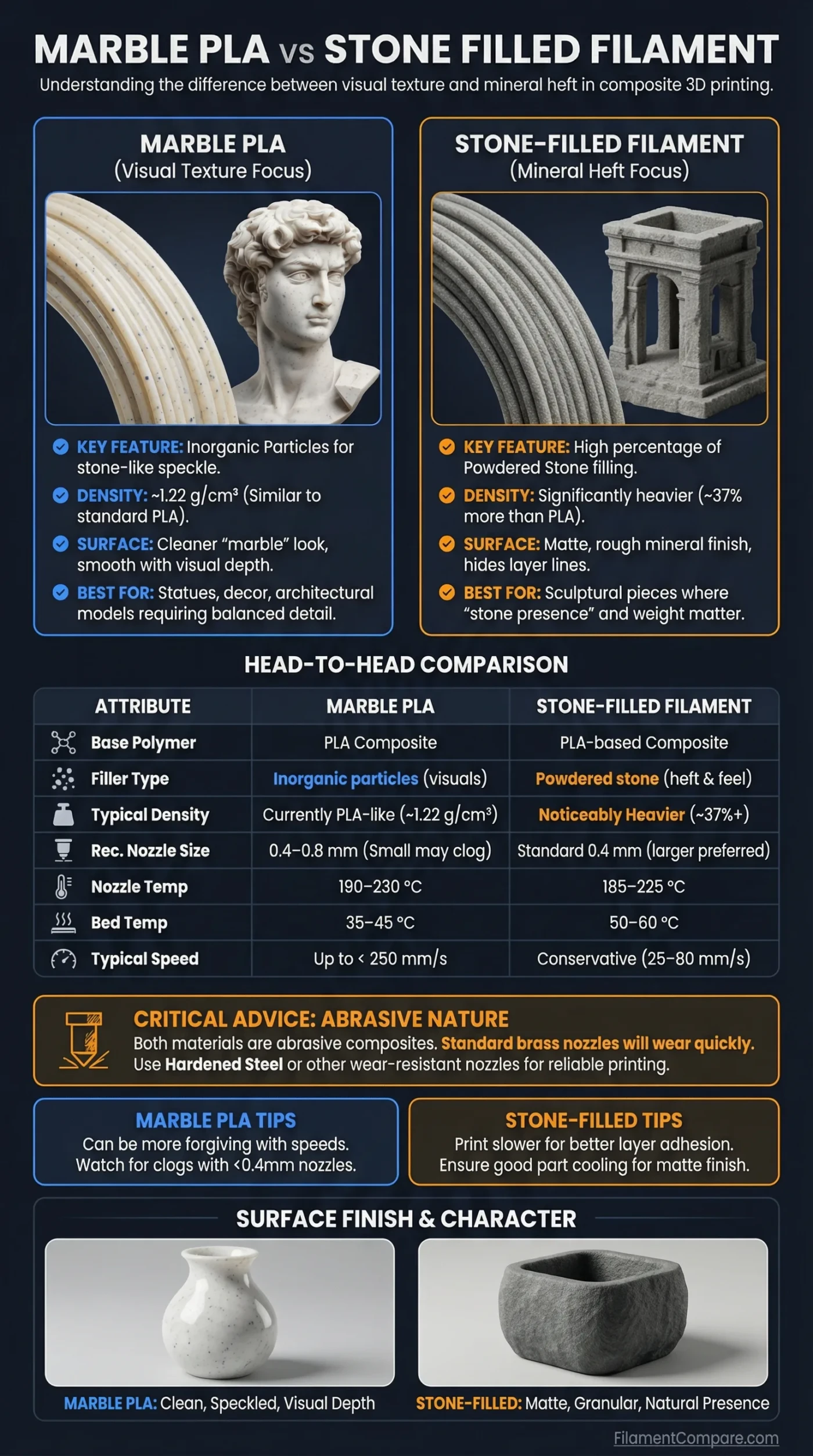
| Attribute | Marble PLA (Example: PLA Marble Datasheet)[a] | Stone-Filled Filament (Example: High Stone Powder Blend)[b] |
|---|---|---|
| Base Polymer | PLA composite | PLA-based composite |
| Filler Type (What Creates the Look) | Inorganic particles for marble/granite-like speckle | Powdered stone filling (listed at 50% in the example TDS) |
| Typical Density / Weight Cue | Density: 1.22 g/cm³ | Reported as ~37% heavier than regular PLA (trend indicator) |
| Recommended Nozzle Size Range | Listed: 0.4–0.8 mm (small nozzles may clog) | Standard 0.4 mm nozzle referenced in typical composite printing; mineral content often favors larger diameters |
| Nozzle Temperature (Reported Range) | 190–230 °C | 185–225 °C |
| Bed Temperature (Reported Range) | 35–45 °C | 50–60 °C |
| Drying Guidance (Before Printing) | 55 °C for 8 h | 30–40 °C for 6 h |
| Glass Transition Temperature (Tg) | ~56 °C | ~60 °C |
| Heat Deflection Temperature (HDT) | ~53 °C (ISO 75 at 1.8 MPa) | ~55 °C (ASTM E2092, HDT A) |
| Stiffness & Strength (Datasheet Style) | Young’s modulus (X–Y): 2330 ± 240 MPa; tensile strength (X–Y): 33 ± 4 MPa | Tensile strength at yield: 60 MPa; flexural strength: 83 MPa (methods differ) |
| Surface Feel | Stone-like speckle, typically cleaner “marble” look | Matte, rough mineral finish with a heavier “stone” feel |
| Typical Speed Guidance | Listed upper guideline: < 250 mm/s | Listed range: 25–80 mm/s |
This Marble PLA vs Stone Filled Filament overview is built from manufacturer datasheets plus trusted reference guidance, so it reflects standard test trends while real-world results can vary by printer, profile, and model geometry.
Both Marble PLA and stone-filled filament aim for a natural, mineral-inspired finish, but they reach that look in different ways. Those material choices show up in weight, texture, flow behavior, and how consistent the surface looks across large walls. If the goal is a reliable “stone vibe” without guessing, the most useful approach is to treat them as two distinct composite families—not just “PLA in fancy colors.”
- Composite PLA
- Mineral Particles
- Matte Finish
- Surface Texture
- Thermal Limits
Marble PLA Snapshot
- Stone-like visuals driven by inorganic particles, often cleaner “marble” speckling.
- PLA-like printing feel, but small nozzles can be less forgiving with particle blends.
- Balanced detail for statues, decor, and architectural models.
Stone-Filled Filament Snapshot
- Mineral heft can be noticeably higher when stone powder content is high.
- Matte, rough surface often hides layer lines naturally on walls and top skins.
- Sculptural feel for decor pieces where “stone presence” matters.
Material Makeup and What “Stone” Actually Means
“Stone look” is not a single recipe. Many marble-style PLAs use inorganic particles mainly to create visual texture, while some stone-filled filaments use a very high fraction of powdered stone to create a heavier, more mineral-like body.
There’s also a third category that confuses buyers: some “stone effect” filaments are designed to mimic stone without actually including stone powder, focusing on an easy-to-process composite approach instead.[c] That single difference can shift how abrasive the filament behaves and how smooth the extrusion feels.
- Inorganic particles
- Small mineral-like inclusions used for a speckled, stone-inspired appearance, often prioritizing visuals over mass.
- Powdered stone filling
- A higher-density filler approach that aims for a more authentic mineral surface and a heavier “stone” feel.
- Composite filament
- A polymer (here, PLA) blended with particles or fibers that influence flow, texture, and mechanical behavior.
Properties That Shift With Filler Content
The most noticeable difference is often mass. High stone powder blends are commonly described as significantly heavier than standard PLA, while many marble PLAs stay closer to typical PLA density. That changes the feel of finished parts and can influence perceived quality in hand-held objects.
Thermal behavior usually remains in the PLA neighborhood. In the example datasheets, glass transition stays around the mid-50s to ~60 °C, and heat deflection temperatures land in a similar range—useful for understanding why these materials often prioritize visuals and surface finish over high-heat environments.
Some PLA grades can develop higher heat resistance through increased crystallinity and controlled post-processing, and technical literature for 3D printing PLA grades explicitly discusses annealing as a route to improved heat deflection performance.[f] That context helps explain why “PLA composite” does not always mean the same thermal ceiling across brands.
Flow, Nozzle Choice, and Wear Considerations
Particle-filled filaments tend to be more sensitive to nozzle geometry, especially at small diameters. Many manufacturers explicitly warn that abrasive composites can wear standard brass nozzles quickly, and hardened steel is commonly recommended in that scenario.[d]
Across datasheets, speed guidance also hints at the difference: marble PLAs sometimes list high ceiling speeds, while high mineral-fill filaments often list more conservative ranges. That aligns with the idea that particle loading can reduce how forgiving the melt is at very high flow rates, even when the base polymer is still PLA.
Neutral takeaway: With composites, the most common variability comes from filler size, filler percentage, and the hotend/nozzle materials—two “stone-like” spools can behave differently even when both are labeled PLA-based.
Surface Finish and Visual Character
Marble PLA typically leans toward a cleaner stone illusion: speckles and subtle veining that reads as “marble” at normal viewing distance. Stone-filled blends tend to emphasize a matte mineral surface, often with a rougher tactile finish that can hide layer transitions on large curved forms.
- Marble PLA look: lighter visual texture, often more uniform walls and highlights.
- Stone-filled look: more granular, natural “stone presence,” usually more matte.
- Brand-to-brand variation: particle recipe can change top-surface feel and wall smoothness.
Air and Handling Notes for Composite Filaments
Thermoplastics can release fumes when processed at melt temperatures, and resin suppliers note that good general ventilation is typically sufficient in many conditions.[e] This is relevant for both marble-style PLA composites and stone-filled PLA composites since both are processed in the same temperature band.
Independent public research groups also evaluate emissions from different printer-and-filament combinations, with a focus on particle size and indoor exposure scenarios.[g] That broader context is useful when comparing composites, especially if the chosen filament encourages extra sanding or surface work for a stone-like finish.
Resources Used
- [a] Bambu Filament Technical Data Sheet V3.0: PLA Marble (PDF)
- [b] FormFutura Technical Data Sheet: StoneFil (PDF)
- [c] colorFabb Technical Datasheet: stoneFill (PDF)
- [d] Prusa Knowledge Base: E3D V6 Nozzles (Hardened Steel vs Brass for Abrasive Filaments)
- [e] NatureWorks Ingeo Biopolymer 4043D Technical Data Sheet (PDF)
- [f] NatureWorks Ingeo Biopolymer 3D870 Technical Data Sheet (PDF)
- [g] US EPA: 3D Printing Research at EPA (Particles and Emissions Overview)
