| Attribute | Flexible PLA (Soft PLA–Style) | TPE Filament (TPU/TPE–Style) |
|---|---|---|
| Material family in plain terms | PLA-based flexible compounds that keep many PLA-like traits | Thermoplastic elastomers built for rubber-like behavior |
| What “TPE” means (chemistry definition) | Usually not classified as TPE; it stays in a modified polylactide family | Elastomer with a thermoreversible network [e] |
| Hardness scale you will see on filament pages | Commonly listed as Shore A for “soft-touch” feel | Most TPU/TPE datasheets list Shore A (sometimes also Shore D) |
| How Shore hardness is typically measured | Durometer indentation methods define types (A, D, etc.) and when to use them [f] | Same durometer family; the key is matching the scale to the material |
| Representative Soft PLA-style datasheet snapshot |
Shore hardness: ~95A Density: 1.4 g/cm³ Tensile strength: ~16 MPa Elongation: ~300% E-modulus: ~380 MPa Vicat softening: ~90°C (Vicat A) Processing temperature: 220–240°C Bed: ~70°C [a] | Values vary by formulation; many TPU grades sit in similar hardness while showing higher stretch and lower stiffness |
| Representative TPU 95A datasheet snapshot | Compared to TPU, Flexible PLA often shows a higher modulus at a similar Shore A feel |
Shore A hardness: 96A Specific gravity: 1.22 g/cm³ Young’s modulus (3D printed): 67 ± 6 MPa Tensile stress at break: 23.7 ± 2.1 MPa (XY) Elongation at break: >560% (XY) MFR: 15.9 g/10 min (225°C, 1.2 kg) HDT (0.455 MPa): 50.3 ± 1.1°C Vicat (A120): 115.7 ± 0.9°C [c] |
| Second TPU/TPE snapshot (shows range across brands) | Flexible PLA “feel” can overlap TPU, yet the structure is typically less elastomeric |
Shore hardness: 95A Density: 1.20–1.24 g/cm³ Elongation at break: 330.1 ± 14% (X-Y) Melt index: 3–6 g/10 min (210°C, 1.2 kg) Equilibrium water absorption: 0.82% [d] |
| Flexible PLA processing + flow indicator example |
Print temperature: 190–230°C MFR (ISO 1133): 8 g/10 min Yield stress (ISO 527): 20 MPa Elongation at break (ISO 527): 180% Density: 1.20 g/cm³ Note: some formulations can soften again from 60°C [b] | TPE/TPU tends to keep elastomeric behavior over a wider range, while always depending on the exact grade |
| Standard reference for MFR/MVR wording in datasheets | MFR/MVR are standardized melt-flow procedures used mainly for quality control [g] | Test temperature and load matter; comparing values only makes sense when conditions match |
| Standard reference for Vicat softening temperature | Vicat methods define heating rate and load options to report when thermoplastics soften rapidly [h] | Filament datasheets may use A50/A120/B50/B120, so like-for-like comparison needs the same method |
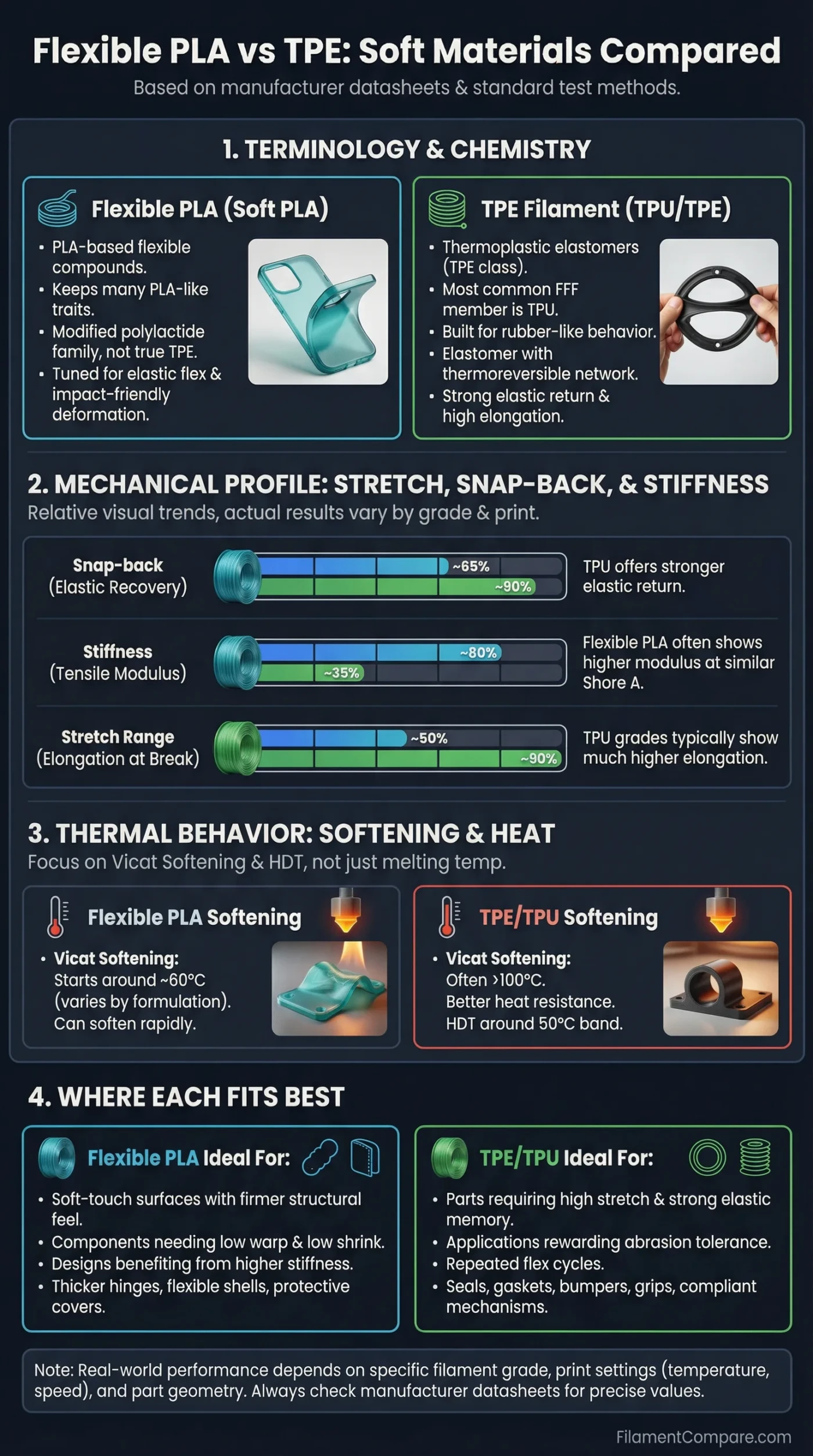
For Flexible PLA vs TPE, the figures below come from manufacturer datasheets plus recognized test-method references, so treat them as standardized trends—real prints can shift with machine, profile, and geometry.
- Terminology That Actually Matters
- Flexible PLA (Soft PLA)
- TPE Filament (Often TPU)
- Mechanical Profile: Stretch, Snap-Back, and Stiffness
- Elastic Recovery vs Stress Relaxation
- Thermal Behavior: Softening, Service Range, and Heat
- What You’ll Commonly See
- Chemicals, Oils, and Moisture: The Quiet Differentiators
- Print Behavior as Data, Not Myths
- Where Each Material Usually Fits Best
- Flexible PLA Often Maps Well To
- TPE/TPU Often Maps Well To
- Spec Sheet Signals Worth Checking
- Resources Used
Flexible prints are often about controlled bend, not just “softness.” In practice, Flexible PLA and TPE (usually sold as TPU/TPE filament) are both part of the wider family of flexible filament materials, and they can feel similar in your hand, yet they behave differently once a part sees repeated bending, constant load, or warm environments.
Terminology That Actually Matters
Flexible PLA (Soft PLA)
- Usually a PLA-based formulation tuned for elastic flex and impact-friendly deformation.
- Often marketed as “Soft PLA” or “PLA Soft,” with Shore A values around the low-to-mid 90s on product pages.
- Commonly described as easy-feeding compared to very soft elastomers, while still being meaningfully bendable.
TPE Filament (Often TPU)
- TPE is a polymer class; in FFF printing, the most common member is TPU.
- Known for strong elastic return and high elongation, often paired with wear resistance.
- Filament datasheets frequently report printed-part properties and highlight orientation effects.
Mechanical Profile: Stretch, Snap-Back, and Stiffness
Most comparisons stop at Shore A. That helps for feel, yet the bigger story is how the part carries load: tensile modulus, yield behavior, and elastic recovery shape what you get after thousands of bends.
Typical Behavior Tends to Look Like This Flexible PLA vs TPE
These bars are a relative visual: datasheets show Soft PLA-style materials often keeping higher stiffness, while TPU-style TPE tends to offer broader stretch and stronger elastic return.
Elastic Recovery vs Stress Relaxation
When a part is held bent for hours, the question becomes creep and relaxation. TPE grades are built to behave elastomerically, so they often keep springiness under repeated cycles, especially at moderate strains.
Flexible PLA can still do impressive bending, yet many formulations lean more toward “flexible plastic” than “rubber.” That difference shows up as a slightly firmer return and a more shape-holding feel in thicker sections.
Data reading tip: Tensile numbers can shift a lot between “molded specimen” and 3D-printed specimen. When a datasheet reports printed results (and print orientation), it is usually closer to what you will experience in real parts.
Thermal Behavior: Softening, Service Range, and Heat
Soft materials can feel stable at room temperature, then change fast near softening points. For flexible filaments, look for Vicat softening and HDT rather than only melting temperature.
- Vicat Softening Temperature
- A standardized way to report when thermoplastics start to soften rapidly; method choice (A/B, 50/120) can change the number.
- HDT (Heat Deflection Temperature)
- A load-based metric that matters for parts under stress; for elastomers, it often reads lower than Vicat but stays useful as a comparison signal.
What You’ll Commonly See
- Soft PLA-style products sometimes note softening behavior starting around 60°C, depending on formulation.
- TPU-style TPE datasheets often list Vicat values above 100°C and an HDT around the 50°C band for the specified load.
- In warm environments, geometry matters: thin flexures behave differently from thick, compression-loaded sections.
Chemicals, Oils, and Moisture: The Quiet Differentiators
Many “soft filament” comparisons skip exposure conditions. In practice, oils, greases, and moisture can change flexibility, friction, and long-term stability, so it helps to treat chemical resistance as a first-class property.
Common datasheet pattern: TPU-style TPE is often marketed for industrial environments and may highlight resistance to oils or chemicals, while some TPU sheets explicitly leave certain solvent categories as “no data.” That “no data” can be as important as a positive claim.
Moisture shows up in two ways: water absorption over time and hydrolysis during melt processing. ISO-style melt-flow reporting exists partly because it gives a repeatable snapshot for QC, and it can also hint at how sensitive a filament is to conditioning before extrusion.
Print Behavior as Data, Not Myths
Both materials can produce smooth, clean flexible parts. The practical difference is feed dynamics: very elastic filaments can compress and snake in long paths, while Flexible PLA formulations often feel more guided and show less “rubber-band” compression during extrusion.
Look at how a datasheet describes testing and specimens. TPU technical sheets commonly call out orientation and printed conditioning, which matters because interlayer strength and elongation can shift dramatically across axes in layered parts.
Where Each Material Usually Fits Best
Flexible PLA Often Maps Well To
- Parts that need a soft-touch surface with a firmer structural feel.
- Flexible components where low warp and low shrink are valued.
- Designs that benefit from higher stiffness at similar Shore A feel (thicker hinges, flexible shells, protective covers).
TPE/TPU Often Maps Well To
- Parts that must stretch far and return with strong elastic memory.
- Use cases that reward abrasion tolerance and repeated flex cycles.
- Seals, gaskets, bumpers, grips, and compliant mechanisms where high elongation is a core requirement.
Spec Sheet Signals Worth Checking
If you want a comparison that stays accurate across brands, focus on the signals that are hardest to fake: test method, conditioning notes, and specimen details.
- Hardness: confirm the scale (Shore A vs Shore D) and whether the sheet references a durometer standard.
- Mechanical properties: check if results are from printed specimens and whether orientation is listed.
- Thermal metrics: prefer Vicat/HDT over “melting temperature” for real-world softening behavior.
- Flow reporting: match temperature and load when comparing MFR/Melt Index values.
- Moisture notes: see whether drying conditions or conditioning time are mentioned in the test notes.
- Variability language: a well-written datasheet usually states that values are for reference and can vary with printing conditions.
Resources Used
- [a] Orbi-Tech: Soft PLA product information (datasheet-style values)
- [b] purefil: Polylactide Soft (PLA Soft) material data sheet (PDF)
- [c] Ultimaker: TPU 95A Technical Data Sheet v5.00 (PDF)
- [d] Polymaker: PolyFlex TPU95 Technical Data Sheet v5.1 (PDF)
- [e] IUPAC Gold Book: “thermoplastic elastomer” (TT07268)
- [f] ASTM: D2240 Standard Test Method for Rubber Property—Durometer Hardness
- [g] ISO: ISO 1133-1:2022 Melt mass-flow rate (MFR) / melt volume-flow rate (MVR)
- [h] ISO: ISO 306:2022 Vicat softening temperature (VST)
