| Category | Conductive Filament | Regular Filament |
|---|---|---|
| Primary Intent | Electrical pathways inside printed geometry; often also supports static charge bleed in practical assemblies. | Structural geometry and general-purpose part making; stays electrically insulating by design. |
| Electrical Range Context (ESD Glossary) [Source-1✅] | Often targets conductive or static dissipative behavior (trend depends on formulation and print orientation). | Commonly sits in the insulative category, with very high resistance that limits charge motion. |
| Representative Datasheet Numbers (PLA-Based Examples) |
Spectrum PLA Conductive reports:
|
NatureWorks Ingeo 3D850 lists:
|
| What’s Inside | Base polymer (often PLA, ABS, PETG, TPU) blended with conductive fillers such as carbon black, carbon nanotubes, or other conductive particles. | Base polymer (PLA/PETG/ABS/TPU and more) formulated for print behavior, strength targets, color, and surface finish—without conductivity-focused fillers. |
| Electrical Behavior in Real Prints | Directional behavior is common: current flow may differ along layers vs through layers, especially in FDM/FFF geometry. | Insulating continuity is typical across directions; parts generally do not form intentional conductive paths. |
| Common Roles in Projects | Sensors, contacts, and ESD-aware fixtures where controlled charge movement is useful; also used for simple conductive features. | Covers, brackets, housings, prototypes, and most everyday printed objects where electrical behavior is not a design variable. |
| Surface Finish Trend | Matte to technical look is common (fillers can influence sheen); fine details are still achievable in many formulations. | Wide aesthetic range (matte, glossy, translucent, silk, special effects) depending on polymer and pigment system. |
| Hardware Interaction Trend | Filled blends can be more abrasive to standard nozzles over time; many users pair them with wear-resistant nozzles in long runs. | Unfilled blends are generally gentler on common brass nozzles in typical use profiles. |
This Conductive filament vs regular filament comparison uses manufacturer datasheets plus an EOS/ESD Association reference, so the figures are standard-range benchmarks and real measurements can shift with geometry, layer direction, and test setup.
- Electrical Behavior and Use Cases
- What Conductive Means in a Printed Part
- What Regular Means in Everyday Filaments
- Typical Applications People Associate With Each
- Material Architecture: What’s Inside The Spool
- Performance Dimensions That Shift the Most
- Electrical Path Behavior
- Mechanical and Thermal Profile
- Measurement Notes That Affect Comparisons
- Application-Focused Matchups
- Where Conductive Filament Commonly Shows Up
- Where Regular Filament Dominates by Default
- Spec Sheet Reading Priorities
- Conductive Paths
- Dissipative Behavior
- Insulating Polymers
- FDM/FFF Reality
- Datasheet-First
Conductive filament is formulated so a printed part can carry electrical charge through its body, while regular filament is formulated to stay insulating and prioritize typical 3D printing goals like fit, finish, and mechanical behavior.
The key difference is not the printer or the toolpath—it’s the material recipe. Conductive blends add a network of conductive particles, so the part can behave more like a controlled resistor than a pure plastic insulator.
Electrical Behavior and Use Cases
What Conductive Means in a Printed Part
In practical FDM parts, conductivity usually shows up as a repeatable electrical path that depends on geometry, layer bonding, and contact points. You often see it treated as “resistance you can design around,” not as a metal-like short.
One example many makers reference is Proto-pasta’s reported values: 15 ohm-cm (molded resin), 30 ohm-cm (printed along layers), 115 ohm-cm (printed against layers), plus a 2–3 kΩ resistance for a 10 cm length of 1.75 mm filament. [Source-4✅]
What Regular Means in Everyday Filaments
Regular filament is the broad category of non-conductive materials (PLA, PETG, ABS, ASA, TPU, and more) where the expected electrical behavior is insulation. That expectation makes it ideal for general objects where electrical conduction is not a design parameter.
- Predictable insulation across most print directions
- Wide formulation variety (stiff, tough, flexible, heat-focused)
- Broader color and finish choices in many brands
Typical Applications People Associate With Each
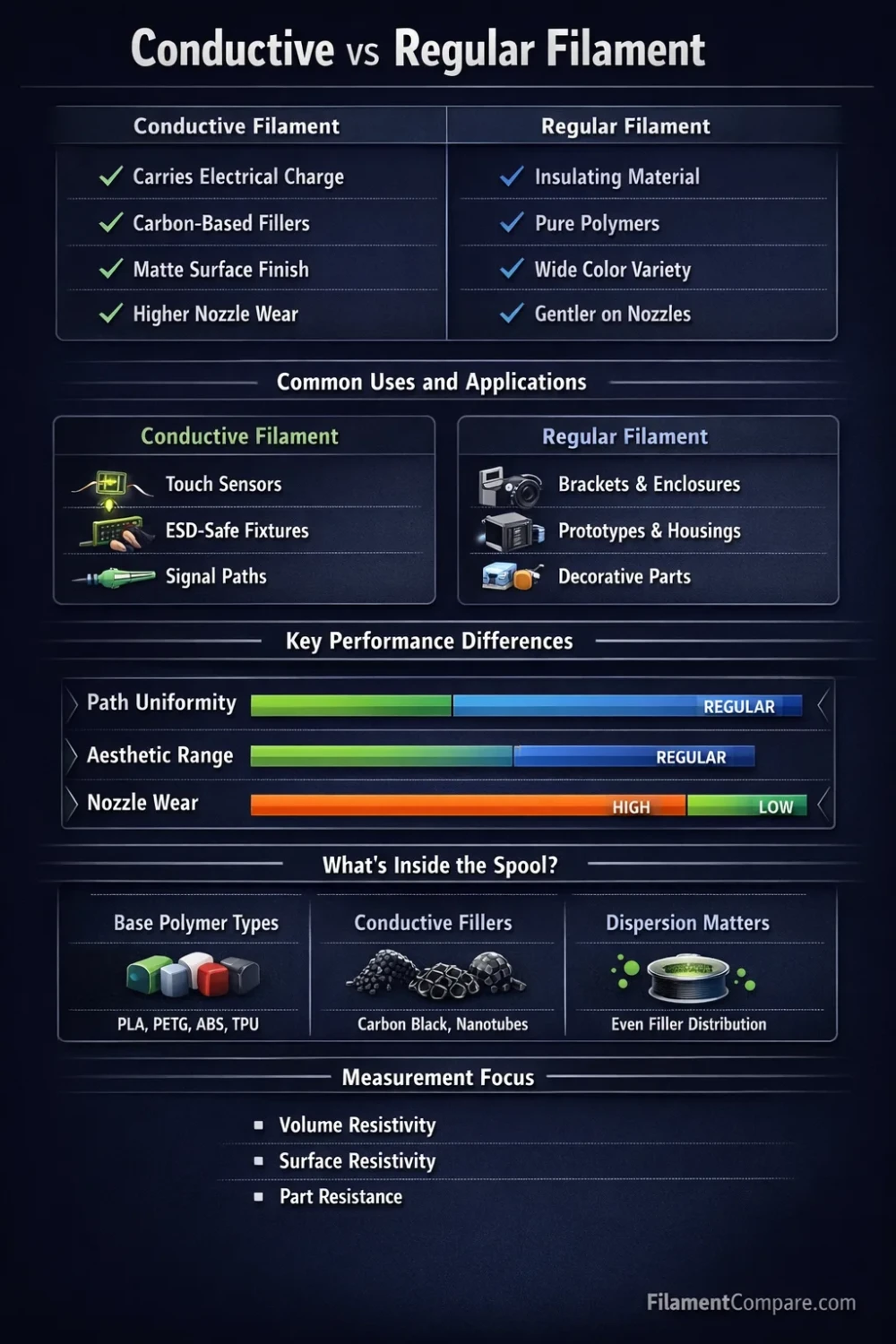
- Conductive filament: touch electrodes, simple signal paths, ESD-aware jigs, sensor housings where charge behavior matters
- Regular filament: brackets, enclosures, cosmetic shells, prototyping parts, functional prints where electrical behavior stays neutral
These overlap more than people expect: many builds combine a conductive feature with a regular structural body, so each material does what it’s naturally tuned for.
Material Architecture: What’s Inside The Spool
Think of conductive filament as a polymer plus an engineered filler network. Think of regular filament as a polymer plus additives that mostly aim at print behavior, color, and mechanical balance.
- Base Polymer
- Regular filament can be PLA, PETG, ABS, ASA, TPU, nylon, and more; conductive filament often starts with similar bases but changes how the blend behaves electrically.
- Conductive Fillers
- Common families include carbon black and carbon nanotubes; the goal is a continuous network so charges can move through the printed body.
- Dispersion and Consistency
- How evenly the filler is dispersed influences path uniformity and repeatability across parts and spools.
Performance Dimensions That Shift the Most
When you compare conductive filament to regular filament, the biggest differences usually show up in how stable the electrical path is, how the surface looks, and how the mechanical profile balances against the added filler.
Relative Trend Bars (visual-only, not measured values)
Electrical Path Behavior
Conductive filament tends to behave like a designed resistance element: geometry, cross-section, and layer direction can influence results. Regular filament tends to behave like a stable insulator, so electrical pathways are usually not part of the design logic.
Mechanical and Thermal Profile
With conductive blends, the filler network can shift stiffness and strength characteristics compared to the same base polymer without filler. Regular filament spans a wider spectrum of mechanical targets because it is not constrained by conductivity-focused additives.
Measurement Notes That Affect Comparisons
When you see electrical specs for conductive filament, you’ll run into terms like volume resistivity, surface resistivity, and simple end-to-end resistance. They describe related things, but they are not interchangeable.
- Volume resistivity focuses on how the bulk material resists charge flow through a defined volume.
- Surface resistivity focuses on charge motion along the surface under defined test conditions.
- Part resistance is the practical “this trace measures X ohms” number, strongly tied to geometry and contact quality.
If two products both say conductive, it can still mean different things: some target stable charge dissipation, some target basic conduction, and the gap between those use cases can be meaningful in real assemblies.
Application-Focused Matchups
Where Conductive Filament Commonly Shows Up
- Touch interfaces and capacitive-style electrodes in printed forms
- Simple current paths inside prototypes where printed conductivity is part of the concept
- ESD-aware fixtures where controlled charge behavior is desired
- Conductive contacts in low-force, low-current experimental assemblies
Where Regular Filament Dominates by Default
- Enclosures, brackets, mounts, and general structural shells
- Aesthetic parts where color and surface finish are priorities
- Functional prototypes where mechanical fit matters more than electrical behavior
- Multi-material builds that isolate electronics from the printed body
Spec Sheet Reading Priorities
If you’re comparing conductive filament listings, the most useful specs are the ones that translate across brands. For regular filament, polymer family and thermal limits usually do most of the explaining.
- Electrical metric type (volume resistivity vs surface resistivity vs part resistance)
- Test condition clues (dry vs humid, molded vs printed, axis direction notes)
- Thermal landmarks (glass transition temperature, melt/processing window)
- Mechanical indicators (modulus, yield strength, elongation) with awareness of specimen type
- Handling signals (storage and moisture notes, especially for consistent extrusion)
When a project mixes electrical features with structure, the clean split is often conductive filament for the path and regular filament for the body. It keeps the design logic simple and makes the material behavior easier to predict.
