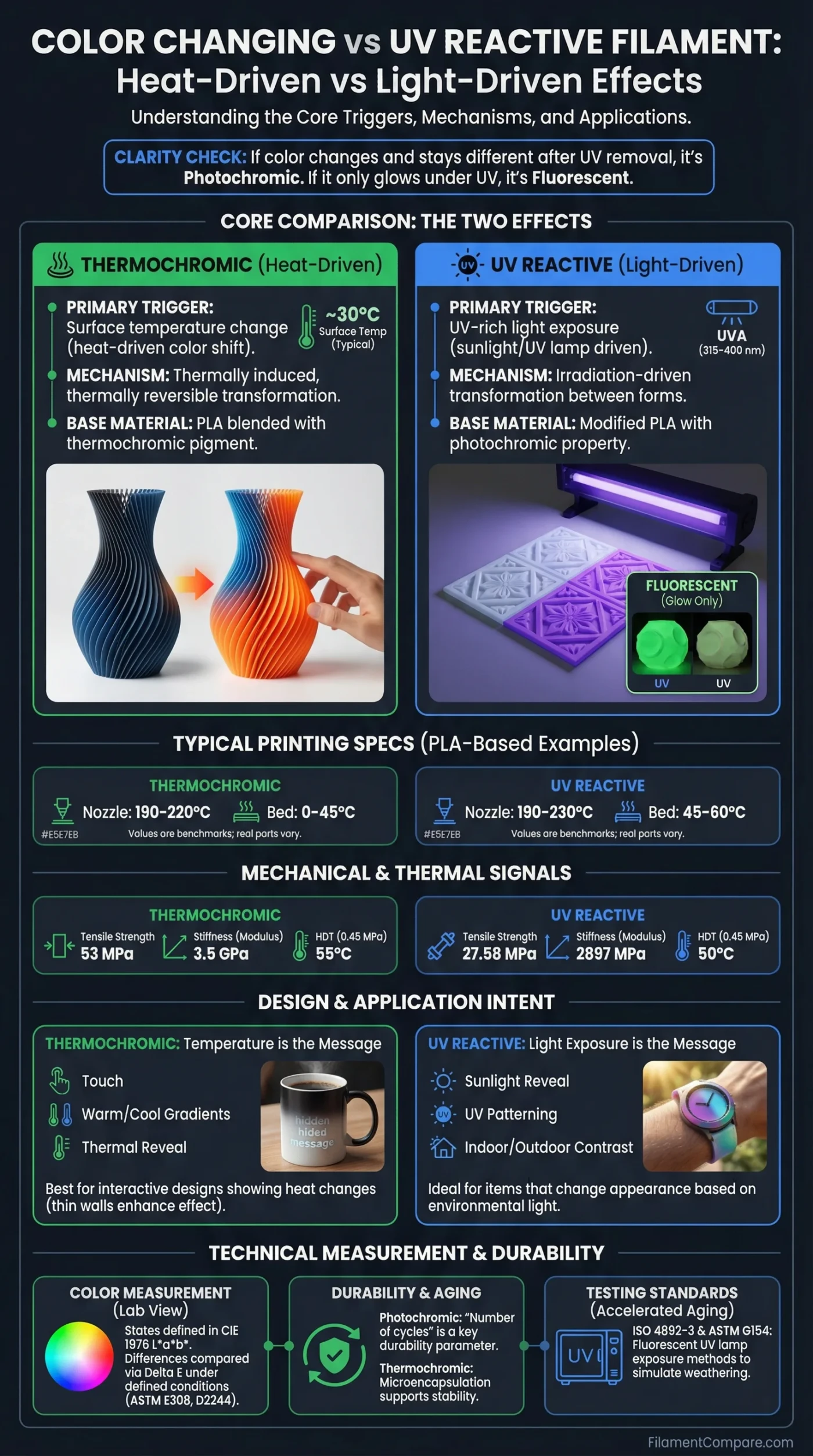
| Attribute | Color-Changing Filament (Thermochromic) | UV Reactive Filament (Photochromic) |
|---|---|---|
| Primary Trigger | Surface temperature change (heat-driven color shift). [a] | UV-rich light exposure (sunlight/UV lamp driven shift). [b] |
| What “UV Reactive” Often Means | Not applicable; this effect is not light-activated. | Usually photochromic (changes color), but some products are “UV reactive” because they are fluorescent (glow under UV without a true state change). [e] |
| Example Base Material Statement | PLA blended with a thermochromic pigment. [a] | PLA modified with a photochromic property. [b] |
| Example Activation Point | Color shift reported at about 30°C surface temperature (example product). [a] | Triggered by light exposure; UV is part of 100–400 nm electromagnetic radiation, with UVA commonly defined as 315–400 nm. [f] |
| Example Nozzle Temperature Range | 190–220°C (example datasheet range). [a] | 190–230°C (example datasheet range). [b] |
| Example Bed Temperature Range | 0–45°C (example datasheet range). [a] | 45–60°C (example datasheet range). [b] |
| Example Density | 1.24 g/cm³ (example datasheet value). [a] | 1.25 g/cm³ (example datasheet value). [b] |
| Example Tensile Strength at Break | 53 MPa (example datasheet value). [a] | 27.58 MPa (example datasheet value; test method differs by datasheet). [b] |
| Example Stiffness (Modulus) | 3.5 GPa tensile modulus (example datasheet value). [a] | 2897.38 MPa flexural modulus (example datasheet value). [b] |
| Example Heat Distortion Temperature | 55°C HDT (example datasheet value). [a] | 50°C at 0.45 MPa (example datasheet value). [b] |
| How Repeatability Is Discussed in Science/Standards | Often treated as a reversible system whose visible change depends on temperature window and matrix stability. [c] | “Number of cycles” is a named parameter for photochromic systems under defined conditions (matrix, temperature, etc.). [d] |
| Common Way to Compare Color States | Many labs express states in CIE 1976 L*a*b* and compare them via a color-difference metric (Delta E) under defined conditions. [i] | |
This comparison between thermochromic color-changing filament and UV reactive photochromic filament is based on official filament datasheets plus trusted standards and academic references; values are typical benchmarks for trend-level comparison, and real printed parts can vary with printer setup, geometry, and environment.
- Understanding the Two Effects: Heat-Driven vs Light-Driven
- Thermochromic Color Change
- UV Reactive Is Often Photochromic
- What These Filaments Usually Are Made Of
- Side-by-Side Spec Signals You’ll See on Datasheets
- Process Window Signals
- Mechanical and Thermal Fields
- How the Trigger Shows Up in Real Parts
- Responsiveness, Repeatability, and Aging
- Comparing the Color Change Like a Lab Would
- Selection Signals That Actually Match User Intent
- Storage, Handling, and Documentation Expectations
- Standards You’ll Commonly See Mentioned Around These Materials
- Resources Used
Color-changing effects in 3D printing usually fall into two big families: thermochromic filament that responds to heat, and UV reactive filament that responds to light. They can look similar in photos, yet the underlying trigger, the way you judge repeatability, and the way you compare datasheets are genuinely different.
- Color-Changing Filament
- Thermochromic
- UV Reactive Filament
- Photochromic
- Fluorescent vs Photochromic
- PLA-Based Special Effects
- CIE L*a*b* / Delta E
- UV Aging Standards
Understanding the Two Effects: Heat-Driven vs Light-Driven
Thermochromic Color Change
In chemistry terms, thermochromism is a thermally induced, thermally reversible transformation that produces a spectral change, often perceived as a visible color shift. [c]
In filament form, the effect is often delivered through pigments that are designed to switch around a target temperature window, so the visible result can be tied to surface temperature rather than the air temperature in the room. [a]
UV Reactive Is Often Photochromic
Photochromism is a reversible transformation where irradiation converts a stable form into another form with a different spectrum, then returns by a thermal or photochemical back reaction. [d]
Also common in product naming is fluorescence, where the material emits light essentially only while being irradiated; this can look “UV reactive” without being photochromic. [e]
Clarity check: If the color is different after you remove the UV light, that’s usually photochromic. If it mainly “glows” only under UV and looks similar afterward, that’s typically fluorescent. [e]
What These Filaments Usually Are Made Of
Many consumer “effect” filaments keep the base polymer familiar, then add a functional pigment system. One thermochromic example is explicitly described as PLA blended with a thermochromic pigment. [a]
A photochromic example is described as a modified version of PLA that retains PLA-like printability while adding a light-driven state change. [b]
- Thermochromism
- Reversible, heat-driven spectral change; visible color change is typical but not mandatory. [c]
- Photochromism
- Reversible, irradiation-driven transformation between forms with different spectra; cycle count under defined conditions is a named durability parameter. [d]
- Fluorescence
- Light emission that occurs essentially only during irradiation, so the “effect” can vanish when the lamp is off. [e]
- HDT (Heat Distortion Temperature)
- A short-term heat resistance indicator measured under a defined load; datasheets may list it with a load value. [k]
- CIE L*a*b*
- A widely used color space for describing object color states and comparing differences numerically. [i]
Side-by-Side Spec Signals You’ll See on Datasheets
When brands publish technical sheets, the cleanest comparison usually comes from looking at base polymer, the effect trigger, and standard mechanical/thermal fields. In the examples used here, both are PLA-based, yet the effect system changes what you should pay attention to first. [a]
Mechanical and Thermal Fields
For a more apples-to-apples read, it helps to notice the test standards referenced on the sheet. Some thermochromic filament sheets cite ASTM methods (density, tensile, impact, DSC), while others cite national standards; both are valid, but they’re not always directly interchangeable. [a]
How the Trigger Shows Up in Real Parts
Thermochromic parts often look most “alive” where the surface can move across the pigment’s switching window, so features like thin walls, fins, or high-surface-area textures can show more gradient than chunky solids. The trigger itself is temperature, not time. [c]
Photochromic parts depend on the UV component of the light source; UV is commonly grouped into UVA, UVB, and UVC by wavelength, and sunlight-driven effects are often tied to UVA (315–400 nm). [f]
If a listing says “UV reactive” but only mentions blacklight glow, that matches fluorescence language more than photochromic language. If it says “changes color in sunlight,” that aligns with photochromism. [d]
Responsiveness, Repeatability, and Aging
Both families are designed to be reversible, yet durability is discussed differently. Photochromic systems explicitly use “number of cycles” under defined conditions as an application parameter, since repeated switching can gradually reduce the amplitude of the effect depending on chemistry and matrix. [d]
Thermochromic systems in coatings and polymers are commonly described as microencapsulated formulations, where encapsulation can support the stability of the functional composition in a matrix. Microencapsulation is frequently highlighted as a practical enabler for service life. [l]
When a project needs a more formal durability conversation, it often turns into accelerated exposure methods. ISO 4892-3 specifies fluorescent UV lamp exposure methods (with heat and water options) intended to simulate weathering effects on plastics. [g]
A parallel reference in many labs is ASTM G154, which is widely used for operating fluorescent UV lamp apparatus and is noted as technically similar to ISO 4892-3. [h]
Relative Comparison Visual (not a lab score)
Thermochromic (Color-Changing) uses fill-cf; UV reactive (Photochromic) uses fill-abs. Bars illustrate typical behavior patterns rather than guarantees.
Comparing the Color Change Like a Lab Would
Many product pages show “before/after” photos, yet serious comparison usually needs a consistent numeric language. A common approach is to express each state in CIE 1976 L*a*b* coordinates. [i]
When the color is measured spectrally, ASTM E308 provides computation procedures used to obtain CIE tristimulus values from spectral data for object-color specimens. [j]
To turn two states into a single “distance,” many workflows use Delta E and tolerance-style comparisons under defined conditions; ASTM D2244 covers calculation of color tolerances and small color differences for opaque specimens. [k]
Selection Signals That Actually Match User Intent
- Thermochromic color-changing filament fits designs where temperature is the message (touch, warm/cool gradients, thermal reveal). [c]
- UV reactive photochromic filament fits designs where light exposure is the message (sunlight reveal, UV patterning, indoor/outdoor contrast). [d]
- If the goal is “glow under blacklight,” product descriptions that align with fluorescence are a closer match than photochromism. [e]
- If the goal is “compare materials fairly,” rely on standardized mechanical testing logic (for example, ISO tensile testing frameworks) rather than photo-only listings. [o]
Storage, Handling, and Documentation Expectations
Effect filaments are still filaments: they typically benefit from being kept dry, away from sunlight and direct heat, and stored at room temperature when possible. One thermochromic PLA sheet explicitly notes keeping the filament out of moisture, sunlight, and direct heat, and lists a shelf life when stored properly. [a]
Datasheets often state that published properties are intended for reference and comparison, and that actual values can vary with printing conditions and environment; treating these numbers as benchmarks rather than promises stays aligned with how suppliers frame them. [b]
Standards You’ll Commonly See Mentioned Around These Materials
- ISO 527-1 for tensile property determination principles for plastics. [o]
- ASTM G154 for fluorescent UV lamp apparatus operation in exposure testing workflows. [h]
- ISO 4892-3 for exposing plastics to fluorescent UV lamps (with defined conditions) to simulate weathering effects. [g]
- CIE L*a*b* definitions and calculation framework for consistent color-state description. [i]
- ASTM E308 for computing object colors from spectral data into CIE values. [j]
Resources Used
- [a] Spectrum Filaments, “PLA Thermoactive” Technical Data Sheet (PDF). Open
- [b] eSUN, “PLA UV Color Change” Technical Data Sheet (PDF). Open
- [c] IUPAC Gold Book, “Thermochromism (T06312).” Open
- [d] IUPAC Gold Book, “Photochromism (P04589).” Open
- [e] IUPAC Gold Book, “Fluorescence (F02453).” Open
- [f] World Health Organization, “Radiation: Ultraviolet (UV)” (UVA/UVB/UVC wavelength ranges). Open
- [g] ISO, “ISO 4892-3:2024 Plastics — Methods of exposure to laboratory light sources — Part 3: Fluorescent UV lamps.” Open
- [h] ASTM International, “ASTM G154 Standard Practice for Operating Fluorescent Ultraviolet (UV) Lamp Apparatus for Exposure of Materials.” Open
- [i] CIE, “Colorimetry — Part 4: CIE 1976 L*a*b* colour space.” Open
- [j] ASTM International, “ASTM E308 Standard Practice for Computing the Colors of Objects by Using the CIE System.” Open
- [k] ASTM International, “ASTM D2244 Standard Practice for Calculation of Color Tolerances and Color Differences from Instrumentally Measured Color Coordinates.” Open
- [l] Springer Nature, “A review of microencapsulated thermochromic coatings…” (PDF). Open
- [o] ISO, “ISO 527-1:2019 Plastics — Determination of tensile properties — Part 1: General principles.” Open
