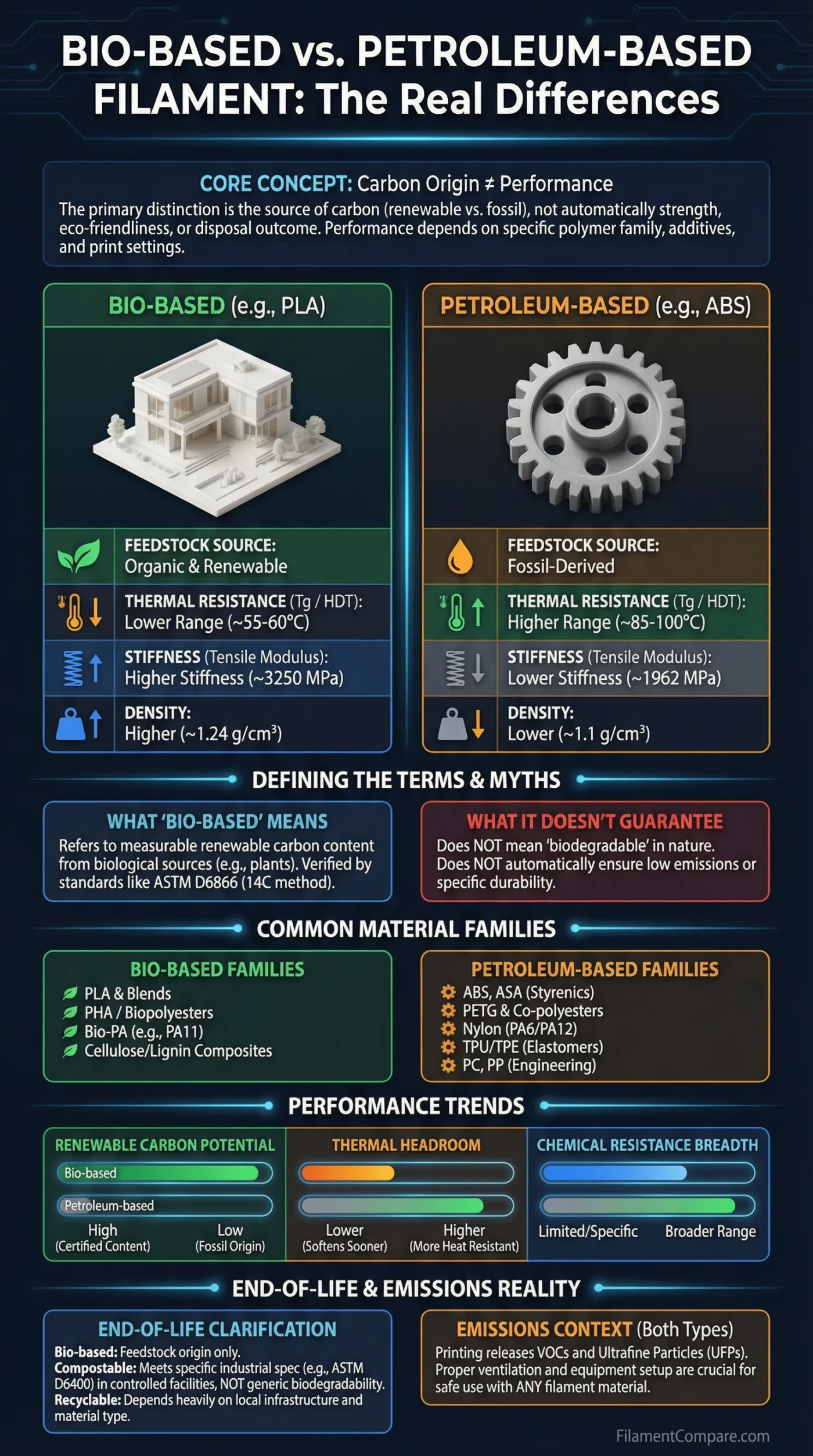
| Attribute | Bio-Based Reference: PLA (UltiMaker)[a] | Petroleum-Based Reference: ABS (UltiMaker)[b] | What This Usually Signals |
|---|---|---|---|
| Feedstock story | Organic & renewable sources are stated for this PLA. | Fossil-derived base is typical for ABS family materials. | Origin of carbon, not automatic “eco” performance or disposal outcome. |
| Glass transition (Tg) | 59.1 °C | 100.5 °C | Thermal headroom before parts soften noticeably in warm environments. |
| Heat deflection (HDT) at 0.455 MPa | 58.8 °C | 86.6 °C | Heat resistance trend under a standardized load condition. |
| Vicat softening temperature | 64.5 °C | 93.8 °C | Softening range that often matches “warm room vs hot room” use cases. |
| Tensile modulus (3D printed, XY) | 3250 ± 119 MPa | 1962 ± 31 MPa | Stiffness trend; printed orientation still matters a lot. |
| Tensile stress at yield (3D printed, XY) | 52.5 ± 0.9 MPa | 38.1 ± 0.3 MPa | Yield behavior varies by polymer family and formulation (additives, impact modifiers). |
| Specific gravity | 1.24 g/cm³ | 1.1 g/cm³ | Mass-per-volume differences can affect spool weight-to-length expectations. |
| Stated “exposed to temperatures higher than…” | 59 °C | 87 °C | Practical guardrail (brand-specific, not a universal law). |
This bio-based filament vs petroleum-based filament comparison uses published datasheets and high-trust references, so the figures show standard-condition trends while real-world results can vary by printer, profile, and formulation.
- What “Bio-Based” Actually Means in Filaments
- Claims, Labels, and How They Get Verified
- Material Families You’ll See in Each Group
- Common Bio-Based Filament Families
- Common Petroleum-Based Filament Families
- Performance Trends That Often Separate the Two
- End-of-Life Words That Commonly Get Mixed Up
- Indoor Air and Emissions Context for FFF Printing
- A Clean Way to Compare Bio-Based vs Petroleum-Based Filament
- Compare Like This (Spec-First)
- Resources Used
“Bio-based filament” and “petroleum-based filament” sound like opposites, yet the real difference is narrower: it’s mostly about where the carbon comes from, not automatically about strength, print behavior, or end-of-life. In practice, filament performance is a mix of polymer family, additives, and how the part is made layer-by-layer.
- Feedstock origin
- Verification standards
- Thermal headroom
- Additives & blends
- End-of-life claims
What “Bio-Based” Actually Means in Filaments
Bio-based refers to renewable biological feedstocks (plants, biomass-derived intermediates, or similar). It does not promise that a filament will break down quickly, and it does not automatically describe emissions, durability, or recyclability. Some major biopolymer platforms explicitly frame bio-based plastics as a low-carbon alternative to petrochemical plastics, focusing on the feedstock and carbon pathway rather than a single “good/bad” label.[d]
- Bio-based
- Carbon content comes partly or fully from recent biological sources; it’s about biobased carbon, not performance.
- Petroleum-based (fossil-based)
- Carbon content comes mostly from fossil hydrocarbons; many engineering polymers fall here, but blends are common.
- Bio-attributed
- A claim often tied to mass balance accounting, where renewable feedstock is tracked in a system even if physical molecules are mixed in production.
- Compostable
- A product label tied to specific standards and conditions (often industrial facilities), not a general synonym for “bio-based.”
For plastics, internationally recognized standards describe how to determine biobased carbon content using 14C measurement methods, which helps separate “renewable carbon” from fossil carbon in a measurable way.[f]
Claims, Labels, and How They Get Verified
If you only look at marketing phrases, bio-based filament can feel vague. Standards-based verification reduces that ambiguity by focusing on measurable carbon. For example, ASTM describes a test method to measure biobased carbon content using radiocarbon analysis and also clarifies what that measurement does not cover (like environmental impact or product performance).[e]
Some certification programs explicitly use these methods to verify percent biobased content. In the USDA BioPreferred labeling context, ASTM D6866 is used to verify biobased content, and the program explains the idea as a ratio of new organic carbon to total organic carbon, with petroleum-origin carbon counted as “old” carbon.[g]
- “Bio-based” claims are strongest when they include a recognized test method or certification path.
- “Bio-attributed” usually points to chain-of-custody accounting rather than a guaranteed physical segregation of molecules.
- “Compostable” should connect to a compostability specification (not just “plant-based” wording).
On the “bio-attributed” side, mass balance frameworks allow certified and non-certified materials to be physically mixed while sustainability characteristics are controlled via bookkeeping. ISCC PLUS describes mass balance as a chain-of-custody method with guardrails so entities can’t claim more certified output than sourced, supporting renewable and recycled feedstocks in existing production systems.[h]
Material Families You’ll See in Each Group
“Bio-based” and “petroleum-based” describe feedstock, but shoppers usually encounter them as familiar polymer names. Most “bio-based filament” pages over-focus on PLA alone; in reality, bio-derived options can include blends and engineering families, while petroleum-based covers a wide spread from easy all-rounders to high-performance materials.
Common Bio-Based Filament Families
- PLA (polylactic acid) and PLA blends
- PHA / biopolyester blends (brand-dependent)
- Bio-based polyamides (example families like PA11)
- Cellulose-filled or lignin-blended composites
- Bio-attributed variants of “standard” polymers (mass balance claims)
Common Petroleum-Based Filament Families
- ABS, ASA, and related styrenics
- PETG and co-polyesters
- Nylon (PA6/PA12 families and blends)
- TPU/TPE elastomers
- PC, PP, and other engineering polymers (printer-dependent)
Performance Trends That Often Separate the Two
Across many brands, bio-based filament (often PLA-led) tends to emphasize dimensional stability and surface detail, while petroleum-based filament spans a broader range of toughness and temperature resistance. The cleanest way to compare is by standardized thermal metrics like Tg and HDT, plus mechanical data that reflects printed orientation, not just raw resin. Day-to-day reliability for these materials also depends on humidity control and proper filament handling, which are explained in this practical filament storage and drying guide.
Relative Trend Renewable Carbon Potential (depends on certification)
Relative Trend Thermal Headroom (family-to-family varies)
Relative Trend Chemical Resistance Breadth (formulation-sensitive)
One useful middle reference is PETG: it’s often discussed as an all-rounder with higher heat resistance than PLA, and a datasheet example shows an HDT of 76.2 °C and Tg of 77.4 °C, sitting between common PLA and ABS thermal ranges.[c]
Why brand-to-brand results vary: a filament can share the same “PLA” label while having different impact modifiers, nucleating agents, pigments, fillers, and melt-flow targets. That additive package can shift layer adhesion, stiffness, and heat behavior as much as the feedstock category itself.
End-of-Life Words That Commonly Get Mixed Up
A frequent misunderstanding: bio-based does not automatically mean biodegradable, and “biodegradable” does not automatically mean “will disappear in any environment.” Compostability claims usually point to a standard and a facility context, where thermophilic conditions are part of the definition for municipal/industrial aerobic composting.[i]
When a filament or packaging is marketed as compostable, the most meaningful detail is whether the claim is tied to municipal/industrial composting specifications (and what those specs require), rather than a generic phrase. This keeps comparisons between bio-based filament and petroleum-based filament grounded in testable criteria instead of assumptions.
- Bio-based: describes feedstock origin and renewable carbon share.
- Compostable: describes behavior under defined composting conditions and timelines.
- Recyclable: depends on local systems, contamination, and polymer compatibility.
Indoor Air and Emissions Context for FFF Printing
Material choice is also discussed through indoor air research. EPA summarizes that 3D printing processes can release gases and particulates, including VOCs and ultrafine particles, with conditions like material type and printing parameters influencing what’s emitted.[j]
NIOSH also notes user concerns around exposures to ultrafine particles and chemicals in non-industrial settings and frames safe use as a combination of equipment, environment, and work practices, keeping the discussion practical rather than alarmist.[k]
A Clean Way to Compare Bio-Based vs Petroleum-Based Filament
If the goal is a fair comparison, it helps to separate carbon origin from performance. Feedstock origin belongs in a “biobased content” line item; strength and heat belong in mechanical/thermal tables; disposal claims belong in compostability or recycling language. That’s how bio-based filament and petroleum-based filament stop being a vibe and start being a spec discussion.
Compare Like This (Spec-First)
- Biobased content: verified method or certification, not just “plant-based.”
- Thermal behavior: Tg / HDT / Vicat for “warm environment” reliability.
- Printed-part mechanics: modulus, yield, and impact with orientation context.
- Disclosure clarity: “bio-attributed” vs physically segregated renewable content.
- End-of-life language: compostability specifications vs general biodegradability claims.
Resources Used
- [a] UltiMaker / Ultimaker PLA Technical Data Sheet (PDF): https://um-support-files.ultimaker.com/materials/2.85mm/tds/PLA/Ultimaker-PLA-TDS-v5.00.pdf
- [b] UltiMaker / Ultimaker ABS Technical Data Sheet (PDF): https://um-support-files.ultimaker.com/materials/2.85mm/tds/ABS/Ultimaker-ABS-TDS-v5.00.pdf
- [c] UltiMaker / Ultimaker PETG Technical Data Sheet (PDF): https://um-support-files.ultimaker.com/materials/2.85mm/tds/PETG/Ultimaker-PETG-TDS-v1.00.pdf
- [d] NatureWorks (Ingeo biopolymer positioning and feedstock framing): https://www.natureworksllc.com/
- [e] ASTM D6866 (biobased content via radiocarbon analysis): https://store.astm.org/d6866-22.html
- [f] ISO 16620-2:2019 (biobased carbon content based on 14C measurement): https://www.iso.org/standard/72474.html
- [g] USDA BioPreferred Certification Criteria (use of ASTM D6866): https://www.biopreferred.gov/BioPreferred/faces/pages/CertificationCriteria.xhtml
- [h] ISCC PLUS Mass Balance Guidance Document (chain of custody and mass balance rules): https://www.iscc-system.org/wp-content/uploads/2025/12/Mass-Balance-Guidance-document_ISSC-PLUS.pdf
- [i] ASTM D6400 (plastics designed to be aerobically composted in municipal/industrial facilities): https://store.astm.org/d6400-23.html
- [j] EPA 3D Printing Research (VOCs and ultrafine particles overview): https://www.epa.gov/chemical-research/3d-printing-research-epa
- [k] NIOSH (CDC) Approaches to Safe 3D Printing: https://www.cdc.gov/niosh/docs/2024-103/default.html
