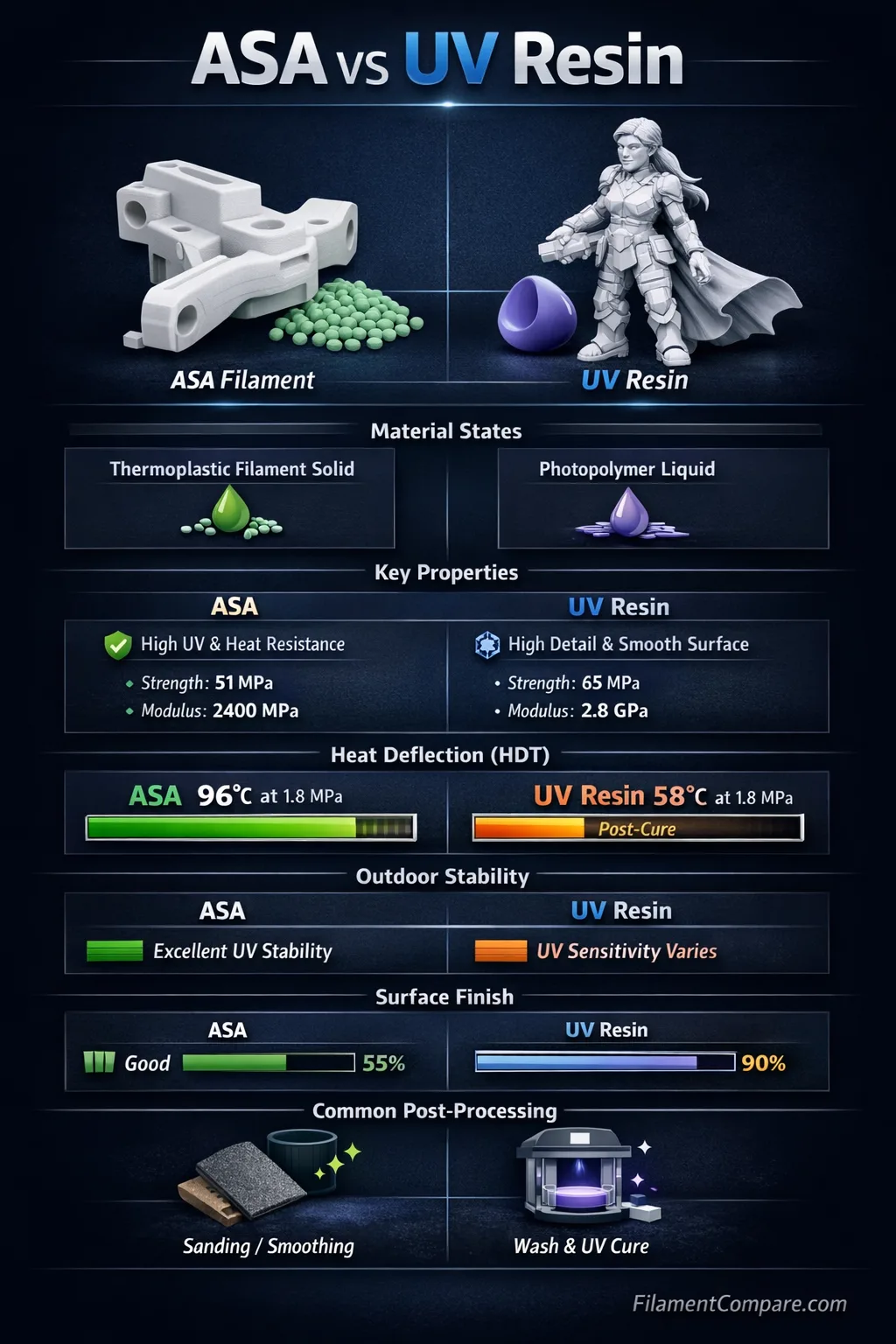
| Aspect | ASA (FDM Filament) | UV Resin (Vat Photopolymer) |
|---|---|---|
| Material State | Solid thermoplastic filament (softens when heated, re-solidifies on cooling) | Liquid photopolymer resin (cures by light into a crosslinked solid) |
| Typical Process Family | Material extrusion (FDM/FFF) | Vat photopolymerization (SLA/DLP/MSLA) |
| Detail And Surface Finish | Clean functional surfaces; visible layer lines depend on layer height and nozzle size | Very smooth surfaces and crisp micro-features; fine detail is a core strength of UV resin |
| Typical Layer Thickness Range | Commonly 0.10 mm and above (filament workflow dependent) | Commonly 0.025–0.5 mm (machine + resin dependent) |
| Strength (Example Datasheet Values) | Yield stress around 51 MPa (ISO 527) | Ultimate tensile strength around 65 MPa post-cured (ASTM D638) |
| Stiffness (Example Datasheet Values) | Tensile modulus around 2400 MPa (ISO 527) | Tensile modulus around 2.8 GPa post-cured (ASTM D638) |
| Ductility (Example Datasheet Values) | Nominal strain at break around 8% (ISO 527) | Elongation at break around 6% post-cured (ASTM D638) |
| Impact Behavior (Example Datasheet Values) | Notched Charpy impact around 12 kJ/m² at 23°C (ISO 179/1eA) | Notched Izod around 25 J/m post-cured (ASTM D256) |
| Heat Resistance (Example Datasheet Values) | HDT around 96°C @ 1.80 MPa (ISO 75) | HDT around 58°C @ 1.8 MPa post-cured (ASTM D648) |
| Water Interaction (Example Datasheet Values) | Water absorption listed around 1.65% (similar to ISO 62) | Water 24-hour weight gain listed as < 1% (typical example in TDS) |
| Dimensional Character | Layer-based and direction-dependent; strong design repeatability in calibrated setups | High dimensional fidelity for fine geometry; orientation + post-cure influence final fit |
| Post-Processing Character | Mechanical finishing (sanding), optional vapor smoothing depending on grade and workflow | Wash + post-cure workflow is part of the normal resin lifecycle |
| Outdoor And UV Exposure | ASA is known for outdoor-minded stability and color retention (grade dependent) | UV resin can be formulated for different targets; long UV exposure behavior depends heavily on resin family |
This ASA vs UV Resin comparison is built from datasheets and trustworthy references, so you’re seeing standardized-test trends rather than a promise of identical results on every printer and every formulation.
- Material Identity and Polymer Chemistry
- ASA As A Thermoplastic Filament
- UV Resin As A Photopolymer
- Mechanical Behavior You Can Compare
- What The Datasheet Numbers Suggest
- Thermal Behavior and Heat Deflection
- Outdoor Exposure and UV Stability
- Process Reality: Heat, Light, and Part Direction
- ASA In FDM Context
- UV Resin In Vat Photopolymerization Context
- Side-By-Side Material Signals
- Chemical Contact and Water Interaction
- Post-Processing and Lifecycle Notes
- Application Fit By Requirements
- Specs That Are Worth Checking On Any Brand Page
If you’re comparing ASA filament and UV resin, you’re really comparing two different manufacturing logics: a heated thermoplastic line that’s placed and cooled, versus a liquid photopolymer that’s selectively cured by light. Both can produce beautiful, accurate parts, but they “win” in different ways.
- ASA: outdoor-ready thermoplastic
- UV Resin: high-detail light-cured polymer
- HDT: heat deflection reference
- Post-Cure: resin properties “lock in” after curing
- Anisotropy: direction-dependent strength
Material Identity and Polymer Chemistry
ASA As A Thermoplastic Filament
ASA (acrylonitrile styrene acrylate) is a thermoplastic often chosen when the end part needs long-term stability under daylight and weather. In datasheets, you’ll often see language like UV stabilized or light-stabilized, which is a big part of why ASA filament shows up in outdoor-focused builds.
Because it’s a melt-and-cool material, ASA lives in the same practical world as other high-temperature extrusion plastics: heat flow, cooling rate, and part geometry matter. That’s not a downside, it’s simply the physics of material extrusion.
UV Resin As A Photopolymer
UV resin sits in the vat photopolymerization family: a liquid resin is selectively cured by UV light to form solid layers. University references describe it plainly as curing liquid photopolymer resin with ultraviolet light, building the model layer by layer [Source-3✅].
Once cured, UV resin becomes a crosslinked solid. That crosslinking is why you often see a clear difference between green (as-printed) properties and post-cured properties on datasheets.
Mechanical Behavior You Can Compare
- Strength
- ASA often shows a “tough technical plastic” profile, while UV resin commonly shifts upward in strength after post-curing.
- Stiffness
- Both can be quite stiff in datasheets; the practical difference is how each process distributes stiffness through the part geometry and orientation.
- Impact
- Impact numbers use different test methods across sources (Charpy vs Izod), so treat them as trend indicators, not a direct apples-to-apples conversion.
What The Datasheet Numbers Suggest
- ASA example values show tensile modulus around 2400 MPa and yield stress around 51 MPa, with nominal strain at break around 8% (standardized specimen testing).
- UV resin example values show post-cured ultimate tensile strength around 65 MPa and tensile modulus around 2.8 GPa, with elongation around 6% post-cure.
Thermal Behavior and Heat Deflection
HDT (heat deflection temperature) is one of the cleanest “compare across materials” numbers you’ll see. It’s still a standardized test, not a universal truth, but it’s useful when you want a realistic sense of how a material behaves under load as temperature rises.
- ASA example data lists HDT around 96°C at 1.80 MPa (and around 101°C at 0.45 MPa), which aligns with why ASA filament is often discussed for warmer environments.
- UV resin example data lists HDT around 58°C at 1.8 MPa post-cure (and about 73°C at 0.45 MPa post-cure), and those post-cured values are a key part of the resin story.
Outdoor Exposure and UV Stability
ASA is widely used for parts intended for extended outdoor use, where UV stability and long-term appearance matter. A well-documented example from a filament maker lists temperature resistance around 93°C and also notes acetone solubility for that ASA formulation [Source-4✅].
UV resin can be engineered for different targets, from visual models to functional parts. When you’re thinking about outdoor exposure, the important detail is the resin family and formulation. It’s normal to see specialized resin options for heat, toughness, flexibility, or flame behavior, each with its own stability profile.
Process Reality: Heat, Light, and Part Direction
ASA In FDM Context
With ASA filament, the part is shaped by controlled melting and cooling. Many reputable printer references describe a heated bed of at least 100°C and a warm, stable environment (often an enclosure) as typical context for this family of material when prints get larger [Source-5✅].
- Geometry Sensitivity: wall thickness, corners, and long spans can influence cooling behavior.
- Layer Bonding: mechanical behavior is often direction-dependent in extrusion builds.
UV Resin In Vat Photopolymerization Context
In UV resin printing, the part’s character is shaped by exposure strategy and curing depth. Because the polymer network is built by light, it’s common to see changes between green and post-cured states on datasheets, especially in strength and stiffness.
- Surface Finish: smoothness is a built-in strength of resin workflows.
- Orientation Effects: accuracy and final fit can shift slightly with cure and geometry.
Side-By-Side Material Signals
Outdoor Exposure Stability (relative, typical)
Fine Detail And Surface Finish (relative, typical)
Heat Under Load (HDT Trend) (relative, typical)
Presentation-Ready Look Out Of Process (relative, typical)
Chemical Contact and Water Interaction
ASA datasheets often list broad chemical media exposure notes (acids, bases, alcohols, oils) alongside water absorption values. That’s useful if you’re thinking about real-world contact like cleaning agents, mild chemicals, or periodic moisture.
UV resin datasheets frequently include a solvent compatibility table because the material’s interaction can differ dramatically by solvent type. In the common “general purpose” resin profile, you may see low weight gain in water and some household liquids, and very specific behavior listed for stronger solvents.
Post-Processing and Lifecycle Notes
- ASA post-processing is typically mechanical finishing and optional surface work depending on your workflow; as a thermoplastic, it remains re-softenable with heat.
- UV resin generally has a defined cured lifecycle: the printed part, the washed part, and the post-cured part can behave measurably differently in strength and heat deflection.
- Dimensional Intent differs: filament parts are shaped by deposition and cooling, resin parts are shaped by exposure and polymerization depth.
Application Fit By Requirements
| Requirement You Care About | Material Signal That Usually Matches |
|---|---|
| Outdoor daylight + long-term appearance | ASA commonly aligns well with UV stability expectations (grade dependent). |
| Very fine surface texture and micro-detail | UV resin is typically chosen when detail fidelity is the priority. |
| Heat under load (fixtures, housings, warm environments) | ASA tends to show stronger HDT trends in common general-purpose profiles. |
| Showcase prototypes and presentation-ready surfaces | UV resin often delivers that smooth look with minimal surface texture. |
| Large build volumes and scalable part size | ASA filament naturally pairs with the broader build volumes common in FDM ecosystems. |
| Tight fit features and small mechanical interfaces | UV resin commonly shines when small geometry accuracy is critical. |
Specs That Are Worth Checking On Any Brand Page
- HDT (with test load stated) for both ASA and UV resin.
- Tensile strength, modulus, and elongation values (and whether the resin is green or post-cured).
- UV stability language for outdoor parts, especially for long exposure scenarios.
- Post-cure requirements for resin and whether the published properties assume post-curing.
- Dimensional notes such as shrink behavior, tolerance language, and test specimen orientation.
