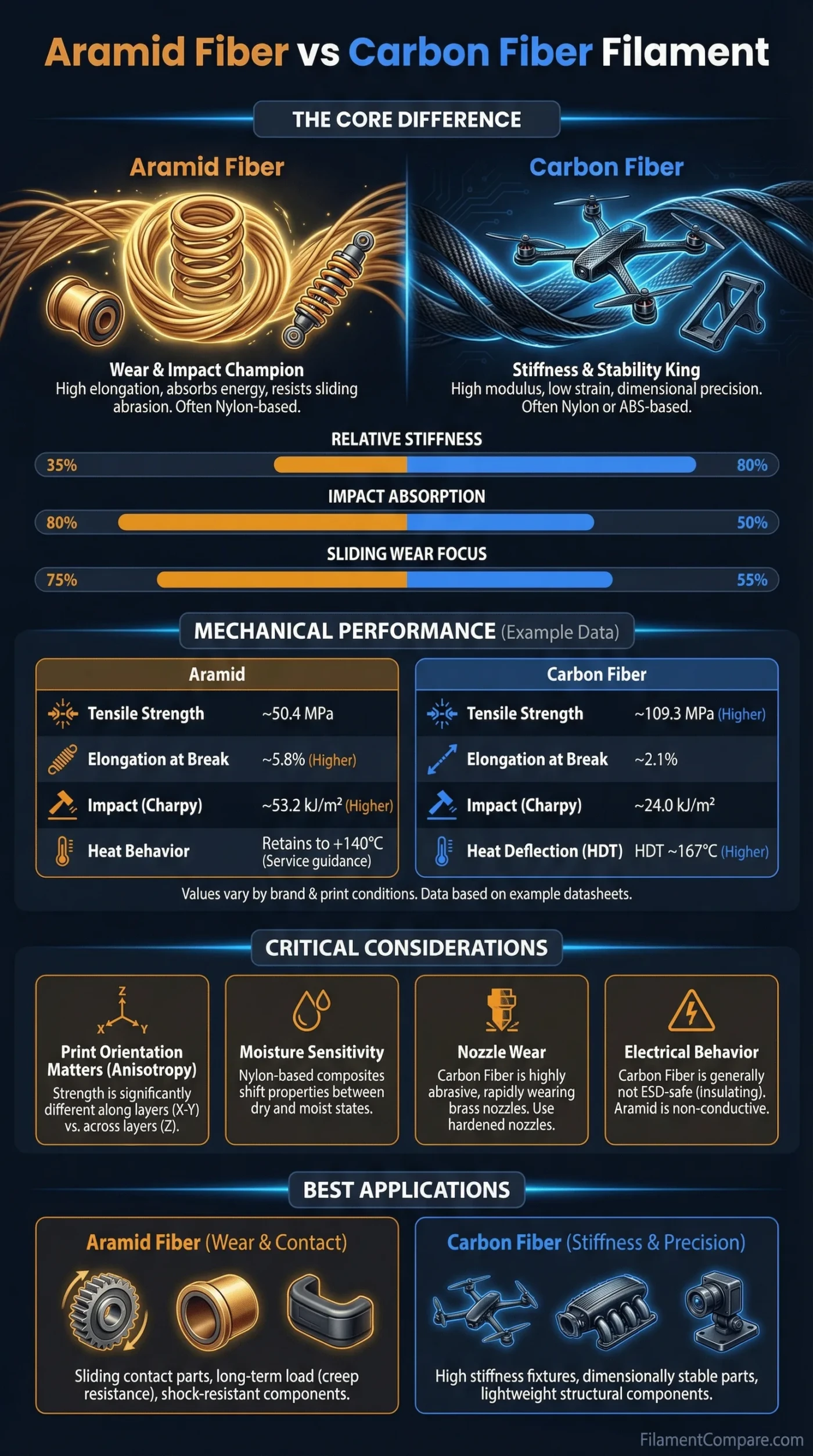
| Spec / Behavior | Aramid Fiber Filament (Example: PA12 + Aramid Fill) | Carbon Fiber Filament (Example: PA6 + Carbon Fill) |
|---|---|---|
| Matrix polymer + reinforcement | PA12 with 8% aramid fiber fill [b] | PA6 with carbon fiber reinforcement (example grade) [c] |
| Density (g/cm³) | 0.99 (ISO 1183, 20°C) [a] | 1.17 (23°C) [c] |
| Nozzle temperature (°C) | 235–255 [a] | 280–300 [c] |
| Bed / build plate (°C) | 90–110 [a] | 40–50 [c] |
| Tensile strength (MPa) | 50.4 (ISO 527, at break) [a] | 109.3 (ISO 527, X–Y, dry) [c] |
| Tensile / Young’s modulus | 0.51 GPa (ISO 527) [a] | 8.64 GPa (X–Y, dry) [c] |
| Elongation at break | 5.8% (ISO 527) [a] | 2.1% (X–Y, dry) [c] |
| Impact (Charpy) | 53.2 kJ/m² (unnotched, 20°C) [a] | 24.0 kJ/m² (X–Y, unnotched, dry) [c] |
| Heat deflection / heat behavior | Properties retained from −40°C to +140°C (manufacturer guidance) [b] | HDT 167°C (ASTM D648 @ 66 psi) [d] |
| Electrical behavior | Non-conductive positioning in reinforced grade (example) [e] | Surface resistivity reported as >1012 Ω (example CF nylon) [c] |
| Nozzle wear signal | “Less abrasive” vs carbon/glass fibers in one aramid-reinforced grade [e] | Brass nozzle wear flagged; example note: ~9 hours typical brass-nozzle life [c] |
| Common “personality” | Tribology, wear resistance, stable under long-term load [b] | Stiffness-to-weight, dimensional stability, “tooling-like” feel [c] |
This Aramid Fiber Filament vs Carbon Fiber Filament comparison is built from manufacturer datasheets and standards-based test definitions, so it reflects typical trends while real printed results can shift with printer, settings, and geometry.
- What These Filaments Actually Are
- Side-By-Side Performance Themes
- Mechanical Properties (And Why Direction Matters)
- Aramid Fiber Filament: What the Numbers Suggest
- Carbon Fiber Filament: What the Numbers Suggest
- Tribology and Wear: The “Quiet” Reason Aramid Gets Picked
- Thermal Behavior and Dimensional Stability
- Two Legit Ways Datasheets Describe Heat
- Moisture and Conditioning: A Big Source of “Spec Drift”
- Example Snapshot: CF Nylon Dry vs Wet (X–Y Direction)
- Electrical Properties and ESD Assumptions
- Hardware Interaction: Nozzle Wear and Flow Behavior
- What Datasheets Commonly Call Out
- Common Fit by Application “Shape” (Neutral, Practical)
- Aramid Fiber Filament Often Matches
- Carbon Fiber Filament Often Matches
- Resources Used
Aramid fiber filament and carbon fiber filament are composite filaments: a base polymer (often nylon or ABS) reinforced with short fibers to change stiffness, wear behavior, and dimensional stability.
What These Filaments Actually Are
Both materials are “matrix + reinforcement” systems, where the polymer matrix defines most print temperatures and moisture sensitivity, while the fiber changes mechanical response and shrink behavior.
- Matrix polymer
- The main plastic phase (PA12, PA6, ABS, etc.). It largely determines nozzle/bed range and water uptake behavior.
- Chopped fiber reinforcement
- Short fibers dispersed in the melt. It commonly boosts stiffness and reduces creep, but results are strongly print-orientation dependent.
- Anisotropy (X–Y vs Z)
- Printed parts behave differently along layers vs across layers; many datasheets report separate values for in-plane and through-thickness directions.
- Tribology
- Friction + wear behavior in sliding contact (gears, bushings, bearing-like parts), often a key reason aramid composites are selected.
Side-By-Side Performance Themes
If you only remember one thing, remember this: carbon fiber reinforcement tends to push stiffness up fast, while aramid reinforcement is often chosen for wear and energy absorption.
Relative Tendencies (trend-level, not a guarantee)
Mechanical Properties (And Why Direction Matters)
Most “headline numbers” come from standards like ISO 527 or ASTM D638, but a printed specimen’s direction (X–Y vs Z) can swing the same material’s reported modulus and strength by multiples. [f]
Carbon Fiber Filament: What the Numbers Suggest
- In-plane stiffness can be very high (example: 8.64 GPa X–Y, dry), which is one reason many carbon fiber filament guides emphasize rigidity and dimensional stability in reinforced prints. [c]
- Lower strain is common in data sheets (example: 2.1% X–Y, dry). [c]
- Flexural properties are often reported with standards like ASTM D790 for reinforced plastics. [i]
Why two websites can “disagree” about strength: even with the same polymer family, fiber fraction, moisture state, and specimen orientation change the output. Standards define the method, not the print setup. [h]
Tribology and Wear: The “Quiet” Reason Aramid Gets Picked
Many comparisons stop at tensile strength, then miss the point: some aramid-filled nylons are explicitly positioned for tribological properties and wear resistance in parts like bearings, cogwheels, and unwinding wheels. [b]
- Sliding contact parts where surface durability matters (bushings, low-speed gears) are frequently named in aramid-filled nylon positioning. [b]
- Creep resistance (holding shape under long-term load) is highlighted in aramid composite descriptions. [b]
- In at least one aramid-reinforced ABS composite listing, the fibers are described as less abrasive than carbon and glass fibers. [e]
Thermal Behavior and Dimensional Stability
“Heat resistance” can mean several different tests, so comparing like-for-like helps: some CF nylons publish a heat deflection temperature, while aramid composites may emphasize operating ranges and stability under load. [d]
Two Legit Ways Datasheets Describe Heat
Moisture and Conditioning: A Big Source of “Spec Drift”
Nylon-based composites can shift notably between dry and moist conditions, and some carbon fiber nylon datasheets publish both states plus storage guidance (example: RH below 20%). [c]
Example Snapshot: CF Nylon Dry vs Wet (X–Y Direction)
| Reported Property | Dry Status (X–Y) | Wet Status (X–Y) |
|---|---|---|
| Young’s modulus | 8636.5 MPa [c] | 2508.1 MPa [c] |
| Tensile strength | 109.3 MPa [c] | 54.7 MPa [c] |
| Elongation at break | 2.1% [c] | 7.0% [c] |
- Moisture state (dry vs conditioned) can shift stiffness and strength in nylon composites. [c]
- Specimen orientation (X–Y vs Z) is not a footnote; it can be the main story for fiber-filled filaments. [c]
- Some datasheets include drying and annealing recommendations (example: 100°C/10h drying, 100°C/16h anneal). [c]
Electrical Properties and ESD Assumptions
Carbon fiber “sounds conductive,” but composite filaments don’t automatically become ESD-safe; one carbon fiber reinforced PA6 datasheet reports surface resistivity above 1012 Ω, which sits in insulating territory. [c]
On the aramid side, at least one aramid-reinforced filament is explicitly described as non-conductive and positioned for shock resistant parts. [e]
Practical takeaway: if electrical behavior matters, treat it as a spec line item and look for a measured resistivity value, not a fiber name guess. [c]
Hardware Interaction: Nozzle Wear and Flow Behavior
Fiber-filled filaments can change how your hotend “feels” over time; for carbon fiber composites, some datasheets directly warn that brass nozzles can wear quickly and recommend wear-resistant nozzle materials. [c]
What Datasheets Commonly Call Out
- Minimum nozzle size may be specified in some reinforced products (example aramid ABS listing mentions 0.5 mm). [e]
- Nozzle durability notes can be explicit for CF nylons (example: “life of a brass nozzle would be ~9h”). [c]
- Test standards like ISO 1183 and ISO 527 frequently appear because density and tensile properties are core comparison anchors. [g]
Common Fit by Application “Shape” (Neutral, Practical)
Thinking in application shapes avoids brand hype: aramid composites often align with wear surfaces and energy absorption, while carbon fiber composites often align with stiffness-driven fixtures and dimension-sensitive parts.
Aramid Fiber Filament Often Matches
Resources Used
- [a] Fillamentum: Technical Data Sheet — Nylon AF80 Aramid (PDF)
- [b] Fillamentum: Nylon AF80 Aramid Product Page (PA12, 8% aramid fiber)
- [c] Polymaker Fiberon: Technical Data Sheet — PA6-CF20 (PDF)
- [d] MatterHackers: Technical Data Sheet — PRO Series Carbon Fiber Nylon (PDF)
- [e] Nanovia: ABS AF — Aramid Fiber Reinforced Filament Reference Page
- [f] ISO: ISO 527-1 — Plastics — Determination of tensile properties (general principles)
- [g] ISO: ISO 1183-1:2025 — Plastics — Methods for determining density
- [h] ASTM International: ASTM D638 — Tensile properties of plastics
- [i] ASTM International: ASTM D790 — Flexural properties of reinforced plastics
